
Encuentran en Bulgaria máscara tracia del siglo IV a.C.
La máscara, que según los arqueólogos perteneció a un rey tracio, fue localizada en una cámara funeraria decorada con paredes de madera.
Sofía, Bulgaria.- Arqueólogos búlgaros encontraron el sábado una máscara tracia del siglo IV antes de Cristo mientras realizaban excavaciones junto a Topolyane, en las cercanías de Sliven, informaron hoy medios locales.
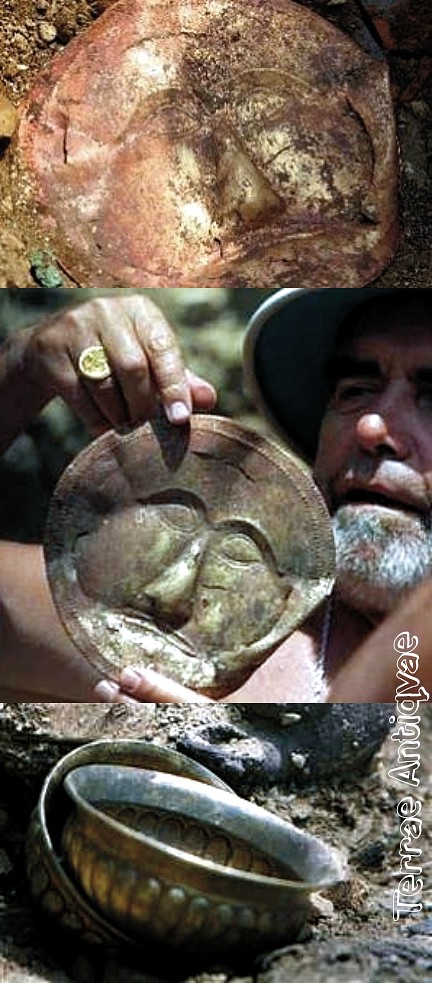
La máscara, que según los arqueólogos perteneció a un rey tracio, fue encontrada en una cámara funeraria decorada con paredes de madera, junto a cerámicas y otros valiosos objetos rituales y fúnebres.
Se trata de la segunda máscara de oro encontrada en Bulgaria en los últimos años, lo que demuestra que el dominio tracio alcanzó una extensión mayor de lo que se creía.
El antiguo pueblo indoeuropeo de los tracios es mencionado ya en La Ilíada de Homero.
Tribus tracias se asentaron en los Balcanes en parte de los actuales Rumania, Bulgaria y Grecia, así como en Asia Menor. El arte de este pueblo se caracteriza por su refinamiento y particular belleza.
Fuente: DPA, 16 de julio de 2007
The first Thracian mask of solid gold ever found
(2) Bulgarian archaeologists discover 2,400-year-old golden mask
SOFIA, Bulgaria: Archaeologists have unearthed a 2,400-year-old golden mask in an ancient Thracian tomb in southeastern Bulgaria, scholars announced Monday.
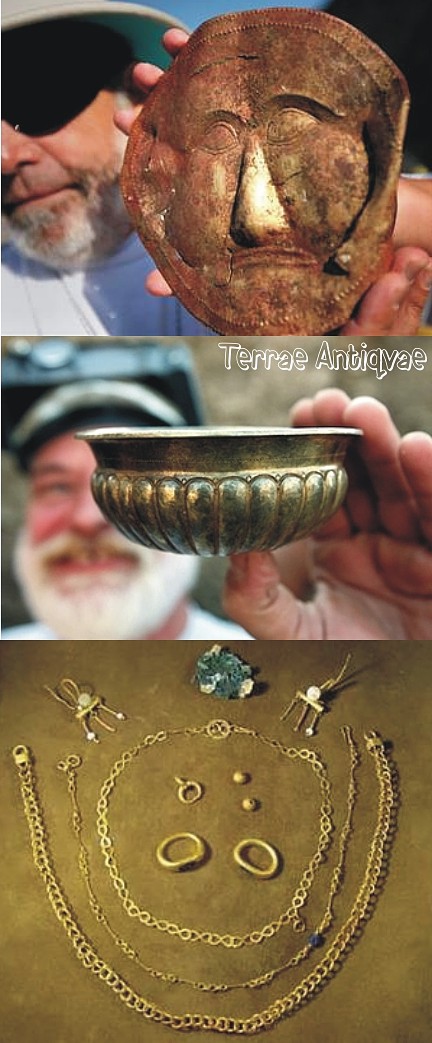
The mask was discovered over the weekend by a team of archaeologists excavating near the village of Topolchane, 290 kilometers (180 miles) east of the capital, Sofia. Its discovery, archaeologists said, indicates a Thracian king was buried in the tomb.
BULGARIA sensation - New Golden Mask of Thracian King Found
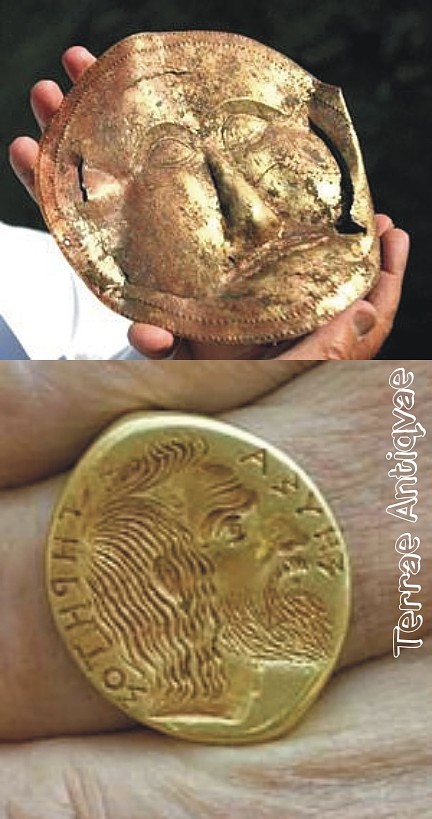
It was found together with a solid gold ring engraved with a Greek inscription and with the design of a bearded man in a timber-lined Thracian grave.
Team leader professor Georgi Kitov said that they also found a silver rhyton, silver and bronze vessels, pottery and funerary gifts.
"These finds confirm the assumption that they are part of the lavish burial of a Thracian king," said professor Margarita Tacheva, who was also on the dig.
"The artifacts belonged to a Thracian ruler from the end of the 4th century B.C. who was buried here," Kitov added.
According to Kitov, the Thracian civilization was at least equal in terms of development to the ancient Greek one.
The Thracians lived in what is now Bulgaria and parts of modern Greece, Romania, Macedonia, and Turkey between 4,000 B.C. and the 8th century A.D., when they were assimilated by the invading Slavs.
In 2004, another 2,400-year-old golden mask was unearthed from a Thracian tomb in the same area.
Dozens of Thracian mounds are spread throughout the central Bulgarian region, which archaeologists have dubbed "the Bulgarian valley of kings" in reference to the Valley of the Kings near Luxor, Egypt, home to the tombs of Egyptian Pharaohs.
Source: The Associated PressPublished: July 16, 2007
BULGARIA Bulgarias GOLD RUSH Valley of the THRACIAN KINGS
BULGARIA - A JOURNEY TO THE LAND OF THE THRACIAN KINGS
ARCHAEOLOGICAL DISCOVERIES IN BULGARIA CONTINUE
12:28 Tue 17 Jul 2007
Days after prominent Bulgarian archaeologist Georgi Kitov found a gold royal mask and other precious artefacts, Polish archaeologist Andrzej Biernacki unearthed a unique Roman pool in the ancient Roman town of Novae, near Svishtov.
The pool has a gate, which had once been decorated with statues. Water poured through the gate on to the pool, Focus news agency reported.
Previously, only one facility like this had been found, in Northern Africa.
The Roman mineral baths in Novae covered 7500 sq m and could turn out to be the biggest found in Bulgaria, Focus said.
Archaeologists suppose that the baths were built for the Roman legions that were based in Novae in the second century.
ARCHAEOLOGISTS SPECULATE THAT RING FOUND IN BULGARIA BELONGED TO THRACIAN KING TERES II
09:01 Wed 18 Jul 2007
The solid gold ring found in a Thracian mound near Sliven on July 15 2007 by archaeologists most probably belonged to Thracian King Teres II, expedition member Yordanka Radancheva said.
King Teres II ruled from 350-341 BCE.
The ring, which has a Greek inscription and the likeness of a man, probably doubled as a seal, Bulgarian news agency BTA said.
The inscription was initially deciphered to read The Saviour of Asia.
Two silver centaurs and a sword that belonged to the interred person were also found at the site. Most of the artifacts found at the site are ornate, which suggests that the people buried there were aristocrats.
Archaeologists see the results of recent excavations as evidence that the Valley of Thracian Kings extends eastward from the Kazanluk area into the Sliven area.
The burial has been initially dated to the fourth century BCE, though some of the artifacts may have been made at an earlier date.
0 comentarios