
Encontrada una daga de oro del 3.000 a.C. en una tumba tracia
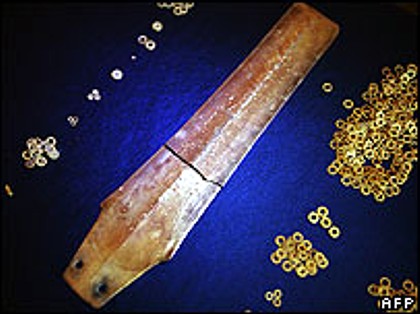
SOFIA (Reuters) - Una daga de oro que data del año 3.000 a.C., junto con otros 500 adornos del mismo metal, fueron encontrados en una tumba tracia en la región central de Bulgaria, anunció el domingo un arqueólogo.
"Es un descubrimiento realmente sensacional", afirmó Bozhidar Dimitrov, responsable del museo nacional de Bulgaria, a Reuters. "La daga, que creemos que está hecha de oro y platino, perteneció probablemente a un gobernante o a un sacerdote de Tracia".
"Nunca se habían encontrado elementos de este estilo ni siquiera en la legendaria ciudad de Troya", apuntó Dimitrov refiriéndose a las ruinas de una de las primeras ciudades de la antigüedad, situadas en Turquía.
El investigador señaló que el puñal, que mide 16 centímetros, había sido fechado en el año 3.000 a.C., está en perfecto estado, y es extremadamente afilado.
Los nuevos hallazgos forman parte de una tumba descubierta hace dos años cerca del pueblo de Dubovo, en el centro de Bulgaria. El año pasado, los arqueólogos encontraron más de 15.000 objetos de toda clase, realizados en oro, con los cuales los restauradores formaron varios collares.
Poco se sabe de los tracios, que vivieron en los márgenes de las civilizaciones griega y romana, y a menudo se entremezclaban y entraban en conflicto con otras culturas más avanzadas.
Algunos expertos sostienen que este pueblo vivieron en una zona que hoy se correspondería con Bulgaria, Rumania, el norte de Grecia y la parte europea de Turquía, desde antes del 4.000 a.C. y hasta que fueron absorbidos cerca del 45 d.C.
"Este importante hallazgo confirma que la gente de esta región estaba familiarizada con lo que en aquella época era alta tecnología en el tratamiento de los metales", añadió Dimitrov.
El investigador dijo que estos artículos podrían haber sido usados para rituales de sacrificio.
Los arqueólogos han descubierto en los últimos año un gran numero de antigüedades en las tumbas tracias de Bulgaria, que desvelaron la mayoría de lo que conocemos de su cultura, como que no tenían un lenguaje escrito ni dejaron registros duraderos.
Fuente: Reuters, 6 de agosto de 2006
Enlace: http://es.today.reuters.com/news/newsArticle.
aspx?type=topNews&storyID=2006-08-06T154700Z_01_CAR655596
_RTRIDST_0_OESTP-ARQUEOLOGIA-BULGARIA-DAGA.XML&archived=False
(2) Ancient dagger found in Bulgaria
By Nick Thorpe, BBC News
It is the latest find from one of many tombs believed to have formed the cradle of Thracian civilisation.
The dagger, made of an alloy of gold and platinum, was found near the village of Dubovo.
Bozhidar Dimitrov, head of Bulgarias National Museum, told Reuters news agency the discovery was "sensational".
It is the latest in a string of finds in the area in recent years which has excited archaeologists and has provided more details of the skills of the still mysterious Thracian civilisation.
According to officials at the museum, the dagger is 16cm (6in) long and is sharp enough to shave with.
More than 500 other miniature gold items were found in the same tomb.
The detail on the dagger suggests that it was used for sacrificial purposes.
Bloodthirsty
The Thracian civilisation thrived on the edge of the ancient Greek and Roman empires in what is now Bulgaria, Romania, northern Greece and Turkey, and is believed to have lasted up to 4,000 years.
The historian Herodotus described the Thracian as savage, bloodthirsty warriors and provided a description of the elaborate funeral procedures for their rulers.
Other finds in recent years include a gold mask, an ancient Thracian temple, a crown and thousands of items of jewellery.
The alloy used in the latest find suggests a far greater degree of sophistication in metal-working that was previously known for that period.
"This significant find confirmed that people in this region were familiar with what was then high technology in metal processing," Mr Dimitrov told Reuters.
Fuente: Reuters / BBC.com, 6 de agosto de 2006
Enlace: http://www.archaeologynews.org/Link.asp?ID=101716
&Title=Ancient%20dagger%20found%20in%20Bulgaria
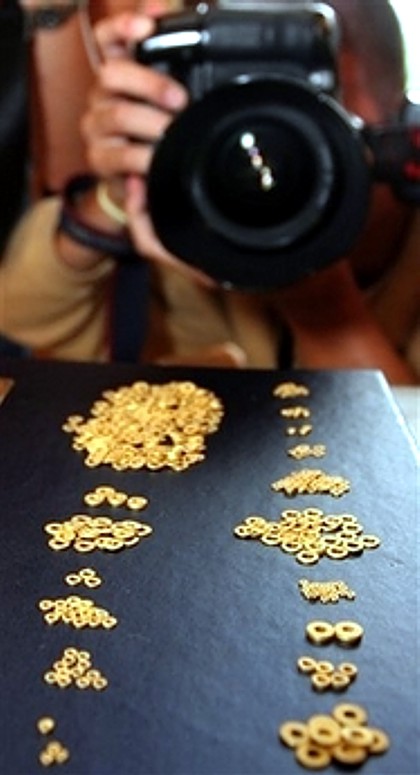
A photographer makes images of pieces of jewellery believed to be about 5,000 years-old, during a news conference in the Bulgarian capital Sofia, Monday, Aug. 7, 2006. Archaeologist unearthed the artifacts in an ancient Thracian complex near the village of Dabene, and suggest that the people who crafted the 16-centimeter gold dagger (unseen here) and the 500 tiny golden rings, were ancestors of the Thracians, who inhabited the lands of present day Bulgaria and parts of modern Greece, Turkey, Macedonia and Romania between 4,000 B.C. and the 8th century A.D. when they were assimilated by the invading Slavs.(AP Photo)
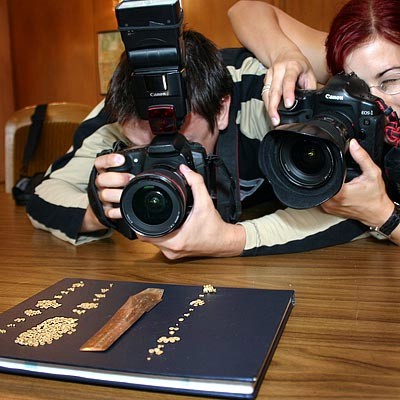
A unique Thracian dagger of gold was found by archeologists in central Bulgaria. All 545 items discovered by the expedition will soon be displayed in Sofia. Photo by Kameliya Atanasova (Sofia News Agency)
2 comentarios
Rossitza Ohridska -
rosdolfo -